A narrow locker, a stack of textbooks that collapses every time the door opens, and a pencil case lost under a pile of loose papers: we all know this scenario. Organizing your school locker well doesn’t require a huge budget, just a few targeted accessories and a bit of method. Here are ten concrete solutions, tested in the field, to keep a functional locker from September to June.
1. Removable shelf to double vertical space
Most school lockers offer a single large compartment without separation. The result: everything gets piled up and the notebooks at the back get squashed. A removable shelf, made of metal or rigid plastic, can be placed without screws or glue and creates two distinct levels.
Place heavy textbooks at the bottom, light notebooks and the pencil case at the top. Separating the levels avoids the “unstable pile” effect that wastes time between classes. If the locker is particularly narrow, opt for an adjustable width model to avoid straining the walls.
When searching for locker organization ideas, this solution often comes up first, and for good reason: it transforms a raw space into two usable zones without any tools.
2. Magnetic bins for small supplies
Pens, erasers, USB drives, headphones: these items systematically migrate to the bottom of the locker. One or two magnetic bins attached to the inside of the door solve the problem. They utilize a surface that is usually wasted.
Slide in the supplies you grab several times a day. The gesture becomes automatic: open the door, grab the pen, close it. No need to rummage. Feedback on magnetic hold varies depending on the thickness of the locker paint, but most models hold well on standard metal lockers.
3. Vertical magazine holder to separate subjects
The magazine holder made of rigid cardboard or plastic is a classic office item, but it works remarkably well vertically in a locker. Align two or three and assign a group of subjects to each: science, literature, languages.
Organizing by subject block rather than by day allows you to only take out the relevant magazine holder before heading to class. You avoid flipping through the entire stack to find the right notebook.
4. Adhesive hooks for bags and accessories
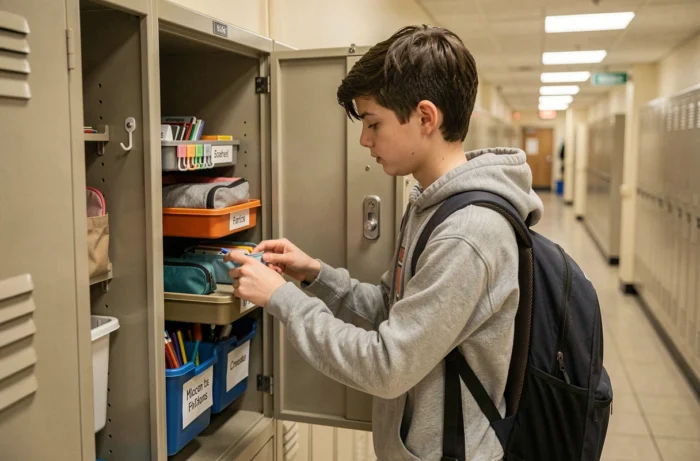
Hanging a small sports bag, a cap, or a spare lock at the back of the locker frees up floor space. Two repositionable adhesive hooks are enough. Attach them to the top of the back wall, at shoulder height.
This detail also reduces the weight carried in the backpack. Distributing items between the locker and the bag lightens the load on your back, a point emphasized by several ergonomic recommendations. Leaving in the locker what isn’t needed for every class (rain gear, sports equipment) makes a real difference throughout the day.
5. Zippered pouches by subject with color coding
Assigning a color to each subject is a simple yet effective method when applied to the locker as well. Use soft plastic zippered pouches, one for each subject, and store loose sheets, corrected papers, and handouts inside.
The color coding speeds up visual identification. You no longer read the labels; you grab the green pouch for science or the red one for French. The pouches also protect documents from creases, a practical advantage when the locker is a bit too full.
6. Rigid lunch box dedicated to the back of the locker
Mixing food and notebooks in the same space causes stains and odors. A rigid box placed at the back of the locker, always in the same spot, isolates lunch from the rest of your belongings.
Choose a container with dimensions compatible with the width of the locker. The trick: lay it flat on the bottom shelf (see idea #1) so it doesn’t tip over. A separate lunch space prevents accidents on the notebooks and makes cleaning up at the end of the week easier.
7. Magnetic whiteboard on the inside door
Sticking a small magnetic whiteboard inside the door turns the locker into a reminder board. You can jot down urgent assignments, test dates, or the list of materials to bring the next day.
This visual reminder appears every time you open it. Unlike a notification on your phone that you swipe away, the whiteboard is physical and permanent. An erasable marker attached by a magnetic cord completes the setup.
8. Adjustable metal bookends
When textbooks and binders are too few to fill the entire width, they slide and sag. Adjustable metal bookends, like spring-loaded bookends, keep the books upright regardless of their number.
Reposition them throughout the year according to the circulating textbooks. This rigidity protects the covers and prevents dog-eared pages. A detail that matters when you have to return the textbooks in good condition in June.
9. Hanging storage net for lightweight items
A net or fabric pouch hung at the top of the locker catches lightweight items that you never know where to put: calculator, glasses, phone charger. Attach it with two hooks or suction cups depending on the locker material.
This storage utilizes the dead space between the top of the books and the ceiling of the locker. You gain several centimeters of depth without cluttering the main shelves.
10. Quick weekly cleaning to maintain organization
No accessory can withstand the accumulation of unnecessary papers and forgotten crumbs. Five minutes of sorting every Friday is enough to avoid chaos. Empty the pouches, throw away obsolete sheets, and check that each item is in its place.
The routine breaks down into three steps:
- Remove everything that no longer belongs in the locker (packaging, returned papers, empty pens).
- Reorganize documents into the correct pouches or magazine holders.
- Quickly wipe down the shelf to eliminate dust and crumbs.
This habit takes less time than a major monthly clean-up and keeps the system in place throughout the school year. A well-organized locker on Friday means a stress-free Monday morning.