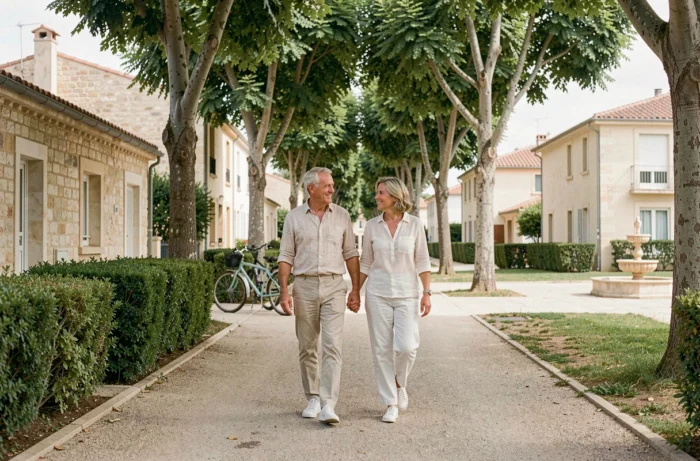
The Grisettes neighborhood combines technical characteristics that distinguish it from most recent urban expansion areas in Montpellier. Eco-district certified ZAC, connection to the urban heating network powered by heat recovery from methane, a twenty-hectare agripark maintained in agricultural operation at the immediate edges of the built environment: the fundamental planning principles go beyond mere environmental display.
Heating Network and Energy Performance in Grisettes
The connection of buildings to the 100% ecological urban heating through methane recovery forms the technical foundation of the neighborhood. This choice of collective infrastructure eliminates dependence on individual gas or oil boilers, with a direct impact on condominium charges and the maintenance of private equipment.
For buyers considering moving to the Grisettes in Montpellier, this heating network represents a concrete long-term advantage. The heating expense, often the most volatile in a housing budget, remains controlled by an energy price decoupled from natural gas prices.
The eco-district certification implies a long-term evaluation, which is not the case for most Montpellier development operations.

Flood Risk in West Montpellier: What the Bypass File Reveals
One point that commercial presentations of the neighborhood almost never address: the western sector of Montpellier is the subject of active discussions regarding flood risk. In 2026, the administrative court of appeal in Toulouse noted an insufficiency in the impact study of the western bypass concerning compensatory measures related to flooding.
The State then submitted additional measures for public consultation, including a drainage channel along the RN109 and a flood expansion area near the Mosson. This file concerns the scale of the entire western Montpellier area.
We clarify that this context is not sufficient to determine the risk on a parcel-by-parcel basis in the Grisettes. A savvy buyer will consult the Flood Risk Prevention Plan applicable to the municipality and verify the exact cadastral situation of the targeted property. Ignoring this dimension would be akin to evaluating the neighborhood solely on its strengths, without considering the hydrological constraints of the Mosson watershed.
Grisettes Agripark: A Green Space That Is Not One
The agripark is not a landscaped park. This distinction is crucial for understanding the real living environment of the neighborhood. The City of Montpellier acquired the vineyard property of Mas Nouguier to create this agricultural space open to the public, involving the removal of old vines and replanting of grape varieties.
The agripark sustains agricultural activity on the fringes of the city, producing a landscape very different from a classic public garden. No mowed lawns or standardized playgrounds, but cultivated plots, walking paths between the rows, and a connection to the Mediterranean terroir that few urban neighborhoods can claim.
For families or retirees seeking a calm environment, this configuration offers a real landscape buffer between the built environment and road infrastructures. The urban density, assumed by the ZAC to meet housing demand, is thus compensated by visual and sound relief over a significant area.

Facilities and Tramway Access: Evaluating Daily Life in Grisettes
The neighborhood benefits from tramway access, ensuring reasonable accessibility to the city center, though it cannot be compared to neighborhoods like Antigone or Port Marianne.
The facilities already delivered deserve a precise inventory:
- The Beethoven school group, which meets the needs for preschool and elementary education without requiring families to travel to other sectors
- Local shops located on the ground floor of buildings, offering food and daily services
- The Saint-Roch Polyclinic and nearby health offices, a concrete asset for access to primary care
- A retirement home and services dedicated to students, reflecting a generational mix rarely achieved in recent eco-districts
This combination of facilities meets most daily needs without motorized travel. For more specialized shopping or cultural leisure, the tramway remains the main mobility vector.
Potential Nuisances Related to the Road Project
The western bypass project in Montpellier, if realized, will alter traffic flows in the area. The consultation file indicates that this project aims to redevelop existing routes. Evaluating the future sound environment of the neighborhood requires monitoring the progress of this file, not solely relying on the current ambiance.
A buyer purchasing in the Grisettes for tranquility must integrate this variable. The current calm of the neighborhood, linked to its position on the urban fringe, could evolve based on infrastructure decisions at the metropolitan level.
Real Estate Investment in Grisettes: New Housing and Social Mix
The ZAC plans approximately 1,500 housing units designed to accommodate Montpellier’s demographic vitality. The neighborhood includes a share of social housing, free ownership, and rental investment, which ensures a diversity of resident profiles in the long term.
The architecture of the neighborhood favors intermediate sizes, neither large complexes nor scattered single-family homes. This positioning corresponds to a controlled density, coherent with tramway access and the proximity of the agripark.
For investors, the eco-district label and connection to the heating network provide measurable asset enhancement arguments. Predictable charges, certified environmental quality, and the presence of structuring facilities form a triptych that secures both resale and rental.
The Grisettes neighborhood will not suit those seeking the urban vibrancy of the historic center or the nightlife of the Écusson. Its positioning lies elsewhere: a sober living environment, technically advanced, with hydrological constraints to monitor and a potential for enhancement linked to the increasing importance of environmental criteria in real estate decisions.