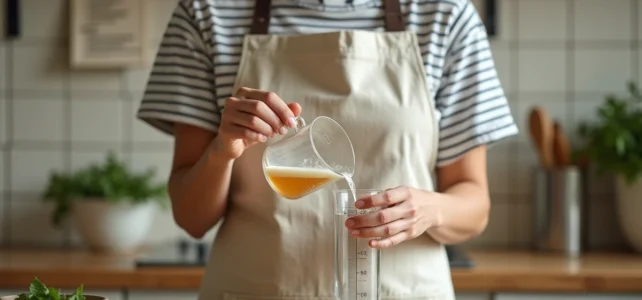
A quarter of a liter is equivalent to 25 centiliters. This conversion is based on a simple rule of the metric system: 1 liter contains 100 centiliters. Dividing 100 by 4 gives 25. This reference point frequently appears in the kitchen, whether the recipe calls for milk, broth, or liquid cream.
The metric system applied to volumes in cooking
The prefix “centi” means one hundredth. A centiliter represents one hundredth of a liter, just as a centimeter represents one hundredth of a meter. This logic allows for easy conversion from one unit to another through simple multiplication or division by 100.
To convert a volume expressed in liters to centiliters, simply multiply by 100. Conversely, to convert from centiliters to liters, divide by 100. Common fractions of a liter in cooking follow this principle without exception.
When a recipe states “1/4 liter of milk,” the calculation is straightforward: 0.25 x 100 = 25 cL. The same operation applies to convert 1/4 liter to cl or any other fraction. One third of a liter gives approximately 33 cL, and one eighth of a liter gives 12.5 cL.
This mechanism remains the same with milliliters. Since 1 liter contains 1,000 milliliters, 1/4 liter also corresponds to 250 mL. Both units (cL and mL) coexist on food packaging and in cookbooks, making it useful to master both.
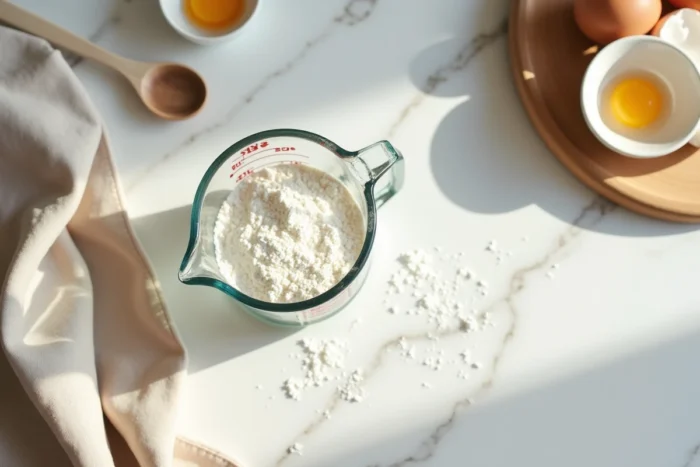
Conversion table for fractions of a liter into centiliters and milliliters
A reference table avoids repetitive calculations while preparing a recipe. Here are the most common fractions in cooking:
| Fraction of a liter | Centiliters (cL) | Milliliters (mL) |
|---|---|---|
| 1/8 liter | 12.5 cL | 125 mL |
| 1/5 liter | 20 cL | 200 mL |
| 1/4 liter | 25 cL | 250 mL |
| 1/3 liter | 33 cL | 330 mL |
| 1/2 liter | 50 cL | 500 mL |
| 3/4 liter | 75 cL | 750 mL |
This table covers the vast majority of volumes requested in French recipes. A quarter liter (25 cL) is particularly common for sauces, pancake batters, or cake mixtures.
Measuring 25 centiliters without a measuring cup
The measuring cup remains the most reliable tool, but it is not always at hand. Several everyday utensils provide sufficiently precise references for home cooking.
- A standard mustard glass holds about 20 cL. To get 25 cL, fill it and then add the equivalent of a large tablespoon.
- A coffee cup holds about 10 cL. Two and a half cups give 25 cL, but this method increases handling and the risk of inaccuracy.
- A tablespoon holds about 1.5 cL (15 mL). Therefore, you would need a little over 16 tablespoons to reach 25 cL, making this option impractical for liquids.
The mustard glass remains the most convenient substitute. Its capacity of 20 cL is a well-known reference, and the additional 5 cL can be easily managed visually for most recipes.

When the precision of volume changes the outcome of a recipe
Not all recipes tolerate the same margin of error regarding volumes. A stew can accept a few extra or fewer centiliters of broth without notable consequences. However, a pancake batter or a custard relies on a precise balance between liquid, flour, and eggs.
In baking, a deviation of 5 cL on a quarter liter of milk alters the final texture. A batter that is too liquid will not rise properly. A cream that is too thick will become grainy when cooked. The volume of liquid directly affects the hydration of the flour and the reaction of the leavening agents.
For emulsified sauces (béchamel, hollandaise sauce), the proportion of liquid determines the viscosity. Adding 30 cL instead of 25 cL of milk in a béchamel results in a sauce that is too runny and will not coat the food properly.
In common savory cooking (soups, marinades, braised cooking), the tolerance is broader. The volume serves more as a rough estimate than a strict measurement. Precision is especially important in baking and emulsified preparations.
Volume conversion and weight conversion: a common confusion
Recipes alternate between grams and centiliters, sometimes in the same list of ingredients. This coexistence creates recurring confusion: 25 cL of an ingredient does not always weigh 250 grams.
For water, the correspondence is exact: 1 mL of water weighs 1 gram, so 25 cL of water weigh 250 grams. Whole milk is very close, with a density slightly higher than that of water. The difference is negligible in cooking.
Oil, on the other hand, is less dense than water. A quarter liter of olive oil weighs less than 250 grams. Conversely, honey is significantly denser: 25 cL of honey weigh much more than 250 grams. Applying the rule “1 cL = 10 g” without distinguishing between ingredients leads to dosing errors.
- Water and milk: the volume-weight conversion is nearly direct (25 cL ≈ 250 g).
- Oil: 25 cL weigh less than 250 g due to a density lower than 1.
- Honey, sugar syrup: 25 cL weigh more than 250 g, as their density far exceeds that of water.
When a recipe indicates a volume in centiliters, it is better to measure the volume rather than the weight, unless you know the exact density of the ingredient in question. A quarter liter remains primarily a measure of volume: 25 cL, 250 mL, regardless of the substance poured into the container.