
On a plot of just a few square meters, the yield of potatoes depends less on the available surface area than on the vertical management of the soil. Each plant produces tubers only on the portion of the stem that is buried: the longer this portion is, the more tubers per plant increase. The entire strategy for harvesting a maximum of potatoes from a small area is based on this principle.
Spacing of plants and planting density in a small garden
The temptation, when space is limited, is to crowd the plants as much as possible. The result is often the opposite of the desired effect: plants competing for light, dense foliage that retains moisture and encourages blight, and tubers that remain small.
A spacing of about three times the width of the seed tuber between each plant, and a sufficient distance between the rows to allow for hilling, remains the functional minimum. Below this, the plant produces fewer exploitable stolons.
To increase density without sacrificing aeration, staggered planting is more effective than a traditional alignment. It allows more plants to fit in the same area while letting air circulate between the foliage. Before optimizing every square meter, it may be useful to read Clic Garden’s articles that detail methods suited for micro-plots.
High hilling and layered substrate to multiply tubers
Hilling is not just a maintenance gesture. It is the main lever for increasing yield per plant on a small surface. Every time the stems are covered with soil or compost, new rhizomes form at the axils of the buried leaves, and each of these rhizomes can produce a tuber.
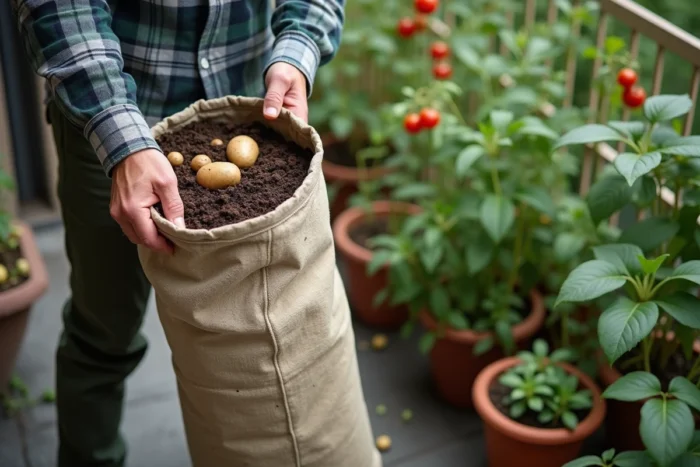
The layer-by-layer method involves planting the tubers at a shallow depth, then gradually adding substrate as the stems grow. The stems are buried to two-thirds of their height with each pass, leaving the top of the foliage exposed.
What substrate to use for layered hilling
A mix of well-rotted compost and garden soil works better than a single substrate. Compost alone retains too much moisture and can cause the tubers to rot during formation. Soil alone compacts and hinders the development of stolons.
The target ratio: about one-third compost to two-thirds soil. This ratio ensures a loose, draining soil that is rich enough to nourish the plant without additional fertilizers.
- First layer at the bottom of the container or trench: garden soil mixed with compost, on which the sprouted tubers are placed.
- Second layer as soon as the stems reach about twenty centimeters: same mix, covering the stems by two-thirds.
- Third layer (and subsequent layers): repeat the operation until reaching the top of the container or a reasonable hilling height, stopping when the plant starts to flower.
Stopping hilling at flowering is a reliable marker. After this stage, the plant focuses its energy on enlarging the already formed tubers, not on producing new stolons.
Water management for potatoes in small spaces
Water is the most underestimated factor in potato cultivation on micro-plots. Technical trials in large-scale farming show that controlled irrigation from emergence increases the number of tubers per plant and improves the uniformity of size.
On a small surface, this principle translates into frequent but moderate watering. The soil must remain cool without ever being waterlogged. Excess water at the level of the tubers encourages scab and blackleg.
Mulching and moisture management at the base of the plants
Mulching plays a dual role in this context: it limits evaporation between waterings and maintains a more stable soil temperature. Straw, dead leaves, or wood chips are suitable, provided that the mulch is not too thick in direct contact with the stems (risk of rot).
The tipping point occurs at the end of the cycle. When the foliage begins to yellow and lay down, watering should be stopped. This drying phase allows the tubers to harden their skin, which improves storage after harvest and reduces the risk of storage diseases.
Selection of productive varieties for high yield per plant
Not all varieties are equal when the goal is to maximize the harvest from a few square meters. Varieties known as “waxy” often produce fewer tubers per plant than starchy storage varieties, but with a more consistent size.
For a small garden, varieties known for their productivity and resistance to common diseases are a safer choice than heritage varieties with low yields. The Vitelotte, for example, is known for its very low productivity and sensitivity to blight. Varieties like Désirée or Princesse Amandine offer a much better ratio between the space occupied and the quantity harvested.
- Favor varieties described as resistant to blight, the most common disease in small spaces where aeration is limited.
- Choose certified seed tubers rather than sprouted consumption potatoes, to avoid introducing viruses into the soil.
- Saving your own seeds from year to year is only relevant if you select tubers from the most productive and healthiest plants.
Managing seeds over multiple seasons allows for gradually adapting the plant material to the specific conditions of the plot, but it requires careful sorting at each harvest.
The final yield on a small surface depends on the interplay of these four levers: controlled planting density, layered hilling, calibrated watering according to the plant’s stage, and selection of suitable varieties. Changing just one of these parameters without adjusting the others limits gains. A covered, cool soil that is regularly raised around the stems remains the most reliable combination to get the best out of every square meter of garden.