
A rainy Sunday afternoon, zero motivation to go out, social battery drained after a busy week. We open an app, scroll, and twenty minutes go by without doing anything satisfying. This scenario is prompting more and more people to rethink their leisure activities as a choice linked to their current state. The trendy leisure activities in 2026 are chosen based on available energy, the need for social connection, and the desire to disconnect from screens.
Choosing a leisure activity based on energy level, not a list
Most guides offer catalogs: sports, cooking, reading, board games. The problem is that you don’t start a running session when you’re drained from five days of intense work. Conversely, staying on the couch with a book when you’re bursting with energy on a Saturday morning creates a dull frustration.
The emerging approach is to sort activities by fatigue level. Specifically, you categorize your options into three tiers: active rest (walking, nature observation, outdoor podcasts), moderate engagement (creative hobbies, cooking, board games), full expenditure (sports, group outings, collective workshops). Before deciding what to do, you ask yourself one question: how is my body feeling?
This framework works particularly well for exploring leisure activities on Buzzarium, where the activities cover a wide spectrum, from calm to very physical. The idea is not to impose a schedule but to match the activity with your actual state.
Birdwatching and nature activities: digital disconnection through the outdoors
Birdwatching is booming, including among young people and beginners. This is not trivial. This activity checks several boxes sought in 2026: no screens, a slow pace, an accessible outing without expensive equipment.
You only need a pair of binoculars and an identification guide (paper or offline app). The rest is time spent outdoors, in silence or in a small group. For those overwhelmed by notifications and digital demands, it’s a leisure format that enforces disconnection without willpower.
Why it works better than a classic digital detox
Declaring a phone-free day isn’t enough if you have nothing to do with your hands and attention. Birdwatching occupies the mind with a concrete goal (spotting, identifying, observing) while allowing the body to rest. You achieve the disconnection effect without the frustration of emptiness.
Nature observation hiking follows the same principle. The outdoor trends of 2026 show an appeal for short outings, often in the morning, where the goal is not performance but attention to living things.
Creative adult hobbies: the flow effect against stress
Adult DIY is no longer limited to Pinterest decor tutorials. In 2026, creative hobbies gain visibility thanks to a health argument: stress reduction through the flow state. We’re talking about short sessions, thirty to forty-five minutes, on manual projects that absorb all attention.
- Embroidery, punch needle, weaving: repetitive actions that calm the nervous system and produce a tangible object in a few sessions
- Handbuilding ceramics (no wheel): accessible at home with a basic kit, no prior skills required
- Textile customization (dyeing, homemade screen printing): a popular format in collective workshops, combining creativity and social connection
The interest of flow is that it doesn’t require being passionate. It just needs to be engaging enough to prevent the mind from wandering to everyday worries. Feedback varies on this point: some find this effect from the first session, while others need a few tries to get absorbed.
Collective leisure and social connection: morning parties, book clubs, and board games
The need for social connection is not met in the same way for everyone. Some want movement and noise, while others prefer a calm setting with few participants. The formats gaining popularity in 2026 reflect this diversity.
Morning parties and active brunches
Morning parties are replacing late-night outings for part of the audience. People meet early, often on weekends, around a gentle physical activity (yoga, dance, walking) followed by a brunch. Social connection is created without the fatigue of an evening. This format particularly appeals to those who work irregular hours or prefer to keep their evenings free.
Book clubs on vacation and among friends
The book club is stepping out of the formal bookstore setting. In 2026, we see groups forming among friends or during vacation rentals, with a book chosen collectively and a moment dedicated to discussion. It’s a low-energy leisure activity that generates connection without requiring logistics.
Next-generation board games
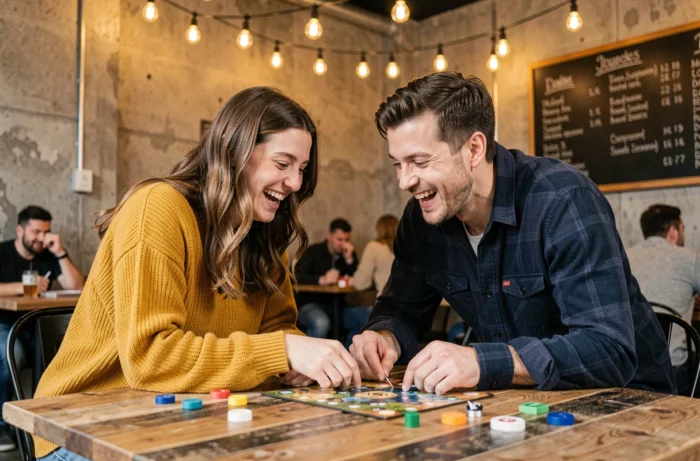
Compact board games, quick to explain and easy to transport, are gaining ground. Several recently released titles aim for games lasting fifteen to twenty minutes, designed for groups of two to six players. They can be slipped into a travel bag or backpack, and they replace scrolling on phones during downtime.
- Short cooperative games: the whole group plays together against the game, eliminating competition and strengthening cohesion
- Casual games with minimal rules: accessible even to occasional players, perfect for breaking the ice
- Narrative or investigative games: each game tells a story, motivating players to replay with a different group
The common thread of these collective leisure activities is that they require neither subscription, specialized equipment, nor lengthy preparation. You choose the format based on the group’s energy and the time available.
The leisure activities of 2026 are no longer just about filling a vacant slot in the week. They meet specific needs: recovering, creating, connecting with others, or disconnecting from the digital world. The most useful filter remains that of available energy at the moment of choice.