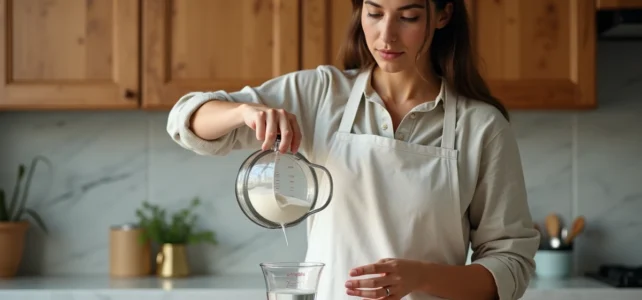
Converting 250 g to ml seems simple as long as you’re dealing with water. Once you switch to flour, powdered sugar, or honey, the result changes drastically. The basic formula (volume = mass divided by density) remains the same, but the density of an ingredient varies depending on whether it is packed, sifted, hydrated, or has been stored for a long time. Understanding these variations helps avoid discrepancies that, especially in baking, can be enough to ruin a dough or batter.
Packed flour, sifted flour: why 250 g does not yield the same volume
Most conversion tables display a single value for flour, often around 55 to 60 g for 100 ml. This range masks a reality that anyone who has opened a bag of T55 flour knows: the volume occupied depends on how the flour is handled.
Flour stored for several weeks becomes compacted under its own weight. The particles come closer together, the trapped air decreases, and the apparent density increases significantly. The same flour, sifted just before measuring, incorporates air and occupies a much larger volume for the same weight.
In practical terms, 250 g of packed flour in a measuring cup may occupy less than 400 ml, while 250 g of freshly sifted flour easily exceeds this mark. The difference is not marginal: it can reach several tens of milliliters, enough to alter the texture of a brioche or cake. To convert 250 g to ml easily, the formula alone is not enough; you must also specify the physical state of the ingredient.
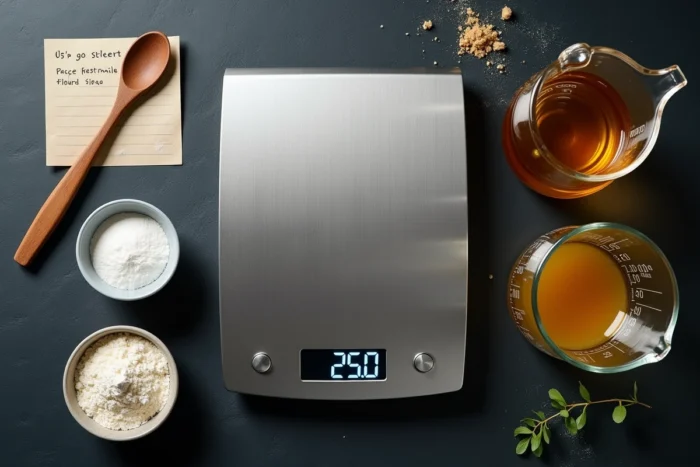
Real density in cooking: what the formula volume = mass / density assumes
The generic formula, volume (ml) = mass (g) / density (g/ml), works perfectly in a laboratory with homogeneous substances and controlled temperature. In cooking, the conditions are less stable.
Liquids: temperature and fat content
Water at room temperature remains the simplest case: 250 g gives 250 ml. Whole milk, with a density close to 1.03, yields about 243 ml for 250 g. Olive oil, being lighter (density around 0.91), occupies a larger volume: 250 g represents about 275 ml.
Honey illustrates the other extreme. With a density close to 1.40, 250 g of honey fills only about 179 ml. The same weight of honey occupies almost half the volume of olive oil. This type of discrepancy makes any “eyeball” conversion absurd without knowing the density.
Powdered solids: the compaction trap
For powders, density depends on granularity and compaction. Granulated white sugar weighs between 80 and 85 g for 100 ml. Powdered sugar, being finer, weighs only about 60 g for the same volume. Thus, 250 g of powdered sugar fills many more milliliters than 250 g of granulated sugar.
Oat flakes pose a similar problem: their apparent density (35 to 40 g for 100 ml) varies depending on whether they are whole, crushed, or packed at the bottom of the bag. The presentation of the ingredient alters the conversion as much as its chemical nature.
Conversions of 250 g to ml for common ingredients
The table below gathers useful benchmarks. The values are approximate and assume an ingredient in its most common state (neither packed nor deliberately aerated).
| Ingredient | Approx. density (g/ml) | 250 g in ml (approx.) |
|---|---|---|
| Water | 1.00 | 250 ml |
| Whole milk | 1.03 | 243 ml |
| Olive oil | 0.91 | 275 ml |
| Liquid honey | 1.40 | 179 ml |
| Flour T55 (not packed) | 0.55 – 0.60 | 417 – 455 ml |
| Granulated sugar | 0.80 – 0.85 | 294 – 313 ml |
| Powdered sugar | 0.60 | 417 ml |
| Raw rice | 0.80 – 0.90 | 278 – 313 ml |
These benchmarks show that 250 g of a light ingredient like flour occupies almost double the volume of 250 g of honey. Consulting this type of table before filling a measuring cup helps avoid unpleasant surprises.
Measuring without a scale: measuring cup, tablespoon, and margins of error
Not all households have a kitchen scale. The measuring cup remains the most common conversion tool, but its reliability depends on how it is filled.
- For a liquid, pour slowly and read the graduation at eye level, the meniscus (the curve of the liquid) should just touch the line. A measuring cup placed on a countertop and read from above gives a distorted reading of a few milliliters.
- For a powder (flour, sugar), fill the cup with a spoon without packing it, then level it off with the back of a knife. Shaking the container or tapping it on the countertop compacts the powder and skews the measurement.
- For a thick substance like honey or heavy cream, the measuring cup is not the best tool: the product sticks to the walls. Weighing to the gram with a scale remains the most reliable method in this case.
The tablespoon can serve as a supplementary reference for small quantities, but extrapolating to 250 g by stacking spoons multiplies rounding errors. It is better suited for adjusting a recipe by a few grams than for measuring a quarter of a kilo.

Adjusting the conversion when the ingredient is more or less hydrated
A parameter often absent from tables concerns the hydration level. Fresh cream, for example, exists in a liquid version (density close to 0.97) and in a thick version (higher density, lower volume for the same weight). Coconut milk concentrate behaves differently from light coconut milk.
Butter also illustrates this variability. Standard butter contains about 82% fat and a bit of water. “Dry” pastry butter, used in professional baking, contains more fat and less water, which slightly alters its density.
- Liquid cream 30%: density of about 0.97, or 258 ml for 250 g
- Thick cream: higher density, lower volume for the same weight
- Melted butter: behaves like a fatty liquid, density close to 0.91
- Solid butter: higher density, 250 g occupies a smaller volume than in melted form
These differences remain modest for a stew but become significant in baking where the proportions of water and fat condition the rise and texture.
The conversion of 250 g to ml only makes sense when related to a specific ingredient, in a specific state. Weighing with a kitchen scale remains the safest method whenever the recipe requires precision. The measuring cup and density tables provide reliable benchmarks as long as one does not forget that the flour from the morning, sifted, does not occupy the same volume as that from the back of the cupboard.