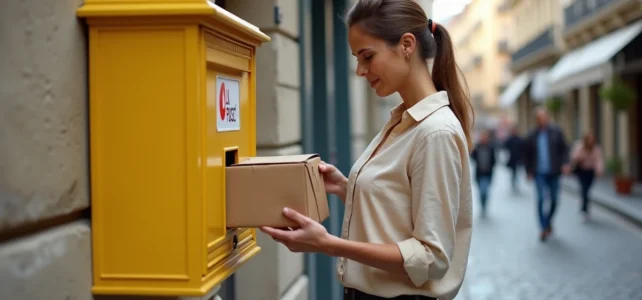
Since the gradual restructuring of La Poste’s office network, returning parcels from the mailbox has become a concrete alternative for individuals. This Colissimo service, accessible without travel, relies on a collection mechanism by the mail carrier during their usual rounds. However, the system raises practical questions that the official pages do not always address in detail.
Physical constraints of the mailbox: what really blocks returns
The first obstacle to returning parcels in the mailbox is not administrative; it is dimensional. Standardized mailboxes in France comply with the NF D 27-404 standard, which imposes a calibrated opening and interior volume for standard mail. A parcel that exceeds these dimensions simply cannot be deposited.
La Poste conditions collection on the parcel’s ability to fit entirely in the mailbox, with the flap closed. In practice, this excludes a significant portion of e-commerce returns, particularly bulky items (small appliances, shoes in their original box, clothing in bulk). The parcel must fit entirely in the box, with the flap closed, without exceeding or blocking the mechanism.
Collective mailboxes in apartment buildings pose an additional problem. Their depth is often less than that of individual mailboxes, and the mail carrier does not always have easy access to retrieve a stuck parcel. In this case, the collection request may go unanswered, without systematic notification of failure.
For buyers who regularly make a parcel return from the mailbox with La Poste, the question of packaging format should be anticipated as soon as the product is received. Keeping a soft pouch or a suitable padded envelope makes the operation much easier than a rigid box.
Colissimo pickup request: the online process and its gray areas
Scheduling the mail carrier’s visit is done on the La Poste website, via the dedicated form for shipping from the mailbox. The process assumes that you already have a prepaid Colissimo label, usually provided by the e-commerce merchant as part of a product return.
Without a prepaid label, the mailbox return service is not accessible. You then need to purchase Colissimo postage online or go to a post office, which negates the interest of the system. Field returns vary on this point: some users report being able to schedule a pickup with postage purchased online, while others have been refused collection due to a label not being in the correct format.
Once the request is validated, the mail carrier is supposed to collect the parcel during their next round. The actual timing of the visit depends on the mail carrier’s workload and the configuration of the route. No specific time slot is guaranteed.
Tracking the parcel after pickup
The Colissimo tracking number is normally activated when the mail carrier scans the parcel. Before this scan, the status remains stuck on “awaiting pickup.” This delay between depositing in the mailbox and the first tracking update can generate anxiety, especially when the return is subject to a withdrawal period.
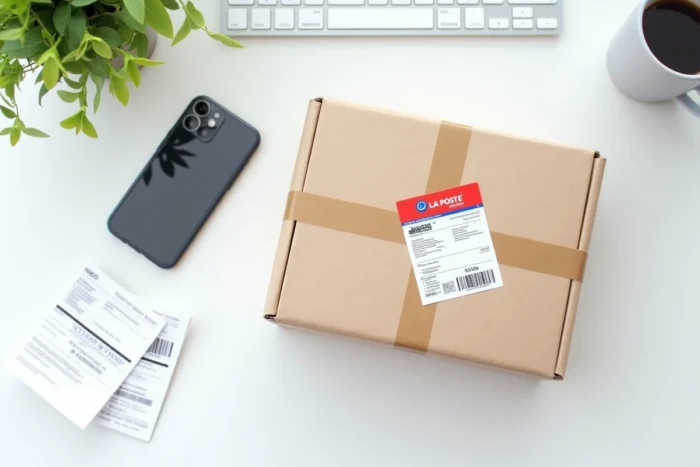
- Check that the label has a readable and unwrinkled barcode, as a failed scan delays the traceability of the shipment.
- Keep a photo of the label affixed to the parcel before depositing it in the mailbox as proof of shipment.
- Monitor the online tracking for two days following the deposit: if no scan appears, contact the Colissimo claims service.
Closure of post offices and shift to the mailbox
A report from the National Assembly on La Poste’s public service missions, published in 2024, documents a marked restructuring of the network. Office closures, partnerships with local businesses, outsourcing of certain services such as collecting registered mail from merchants: the physical accessibility of post offices is decreasing in many areas.
In rural and suburban areas, this trend makes returning from the mailbox not only practical but sometimes necessary. When the nearest post office is several kilometers away, driving for a simple parcel return represents a disproportionate cost and time.
Returning via the mailbox avoids a motorized trip, which can also be viewed in light of the growing expectations for reducing carbon footprints in e-commerce. Existing practical guides rarely mention this aspect, even though it constitutes a concrete argument for consumers sensitive to the environmental impact of their online purchases.
Claim and dispute over a Colissimo return from the mailbox
The most delicate point of returning via the mailbox concerns proof of shipment. Unlike a deposit at a post office where a receipt is issued, depositing in the mailbox generates no paper proof at the time of deposit. The only usable proof remains the online tracking, which is activated only upon scanning by the mail carrier.
If the parcel disappears between the deposit and the scan, the situation is complex. La Poste only recognizes pickup from the moment the parcel enters its tracking system. The sender finds themselves without a clear recourse, and the e-merchant may consider that the return never took place.
- Photographing the parcel in the mailbox with the label visible is the only piece of evidence that can be mobilized in case of a dispute.
- Prefer depositing in the morning, before the mail carrier’s usual passage, to reduce the exposure window.
- In case of a claim with La Poste, the online form requests the Colissimo number and the deposit date: these two pieces of information are essential to open a case.
The Colissimo return service from the mailbox meets a real need, heightened by the reduction of the physical postal network. Its reliability largely depends on the rigor of parcel preparation and the retention of shipping proofs, two elements that the sender directly controls. The main limitation remains the absence of proof at the time of deposit, a blind spot that La Poste has yet to address.