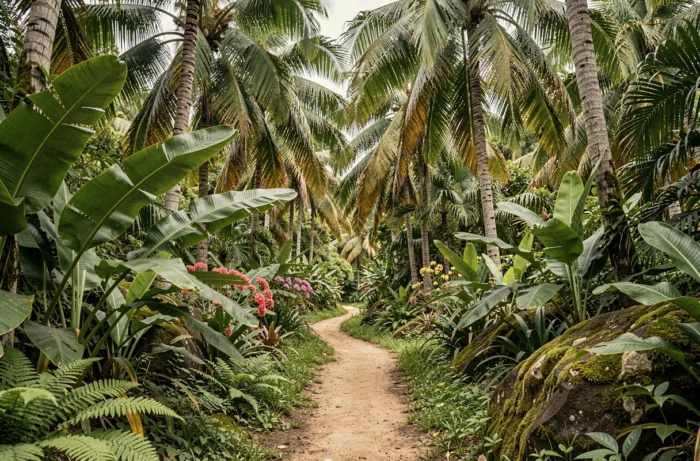
The Guadeloupe archipelago has indeed sheltered several species of snakes, but their populations have collapsed to the point that some have not been observed for decades. Understanding this near-disappearance requires cross-referencing paleontological data, colonial history, and ecological dynamics specific to island environments.
Fossils and archaeological record: what excavations reveal about reptiles in Guadeloupe
Before addressing European colonization and its consequences, we must go further back. The analysis of over 43,000 fossil bones from Guadeloupean archaeological sites has allowed for the reconstruction of the archipelago’s past reptilian biodiversity.
The main finding is one of a great stability of reptilian fauna before the 17th century. Snakes, lizards, and skinks coexisted in dense forest ecosystems, without major human pressure. The Amerindians occupied the islands for nearly two millennia without causing any measurable disruption in the fossil assemblages.
This stability contrasts with what followed. Fossil data show that the reptilian diversity of Guadeloupe was remarkably maintained for a long time, even in the face of climatic and volcanic fluctuations. To delve deeper into the absence of snakes in Guadeloupe, one must therefore look for the cause beyond geology or climate.
European colonization and the extinction of snakes in the Caribbean
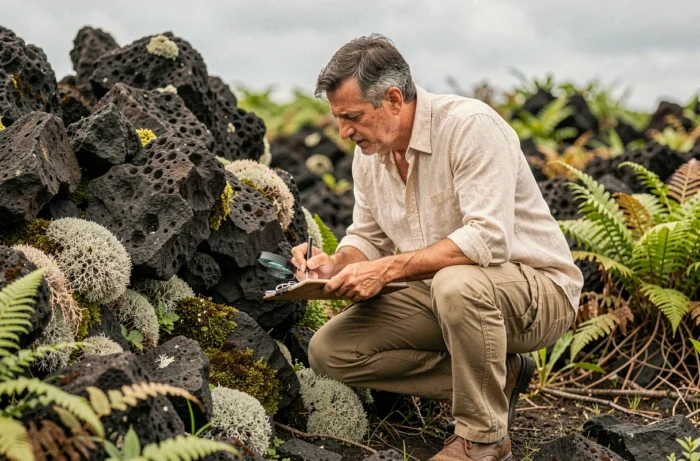
The arrival of Europeans in the 17th century triggered an unprecedented collapse. Extinctions turned out to be far greater than previous estimates suggested. Two main mechanisms explain this catastrophe.
Deforestation and agricultural practices
Intensive cultivation (sugar cane, then coffee and cotton) destroyed most of the forest cover of Basse-Terre and Grande-Terre. Snakes, dependent on forest micro-habitats, lost their refuge and prey within a few generations.
Introduction of exotic predators
Colonists introduced, whether intentionally or not, several species that proved devastating for the local fauna:
- The mongoose, imported to combat field rats in sugar cane plantations, attacked terrestrial snakes and lizards with deadly efficiency
- The domestic cat, which quickly became feral in rural areas, exerted constant predation on small reptiles
- The black rat itself, arriving with ships, raided nests and consumed eggs and juveniles of many species
This cocktail of deforestation and introduced predators struck island species that had never developed defense strategies against such mammals. Small terrestrial snakes were the most vulnerable, as they move slowly and reproduce at a moderate rate.
Surviving species and the current status of snakes in Guadeloupe
Claiming that Guadeloupe has no snakes left would be an excessive simplification. A few species still exist, at least nominally.
The typhlops, a tiny burrowing snake that is nearly blind, persists in some soils of the archipelago. The Guadeloupean racer, a non-venomous snake, still appears in inventories, but confirmed observations have become extremely rare. On the islands of Les Saintes, a distinct racer has been reported, with a concerning conservation status.
The central problem is that the lack of recent observations does not allow for a conclusion between two hypotheses: actual extinction or survival of residual populations in hard-to-access areas. The Guadeloupe prefecture has even launched a call for testimonies from residents, indicating that scientists themselves do not have sufficient data to conclude.

National action plan 2026-2031 for threatened reptiles in Guadeloupe
A recent turning point deserves to be noted. A specific national action plan (PNA) has been published for the period 2026-2031, targeting threatened skinks, racers, and geckos in Guadeloupe and Saint Martin. Coordinated by the DEAL Guadeloupe and led by the Herpetological Society of France with the support of Ardops Environment, this plan structures the response around three axes:
- Knowledge: field inventories, genetic analyses, utilizing citizen reports to locate potential residual populations
- Management and conservation: combating invasive species (mongoose, rat, feral cat), restoring forest micro-habitats favorable to reptiles
- Awareness: mobilizing the public for reporting observations, particularly through participatory science
Twenty concrete actions are planned in this PNA. This initiative marks a methodological shift: instead of limiting itself to academic studies, authorities are now integrating residents into the research process. A farmer, a hiker, or a gardener can become a link in the detection chain.
Why Guadeloupe is not comparable to Martinique for snakes
Martinique is home to the fer-de-lance (trigonocéphale), a well-known venomous snake. This difference with Guadeloupe is due to the distinct biogeographical history of the two islands and human colonization dynamics that did not produce the same effects.
In Martinique, the fer-de-lance survived despite the introduction of the mongoose, likely due to its size, aggressiveness, and ability to occupy varied habitats. Guadeloupean snakes, being smaller and more specialized, did not have these advantages. The fragmentation of the Guadeloupe archipelago into several islands (Basse-Terre, Grande-Terre, Marie-Galante, Les Saintes, La Désirade) also isolated populations, making each group more vulnerable to local extinction.
The idea of a naturally snake-free Guadeloupe is thus a myth. The archipelago hosted a diverse reptilian fauna for millennia. It was the ecological upheavals related to European colonization, combined with the inherent fragility of island species, that caused this near-disappearance. The PNA 2026-2031 establishes for the first time an operational framework with twelve targeted actions to inventory what still survives and organize its protection.