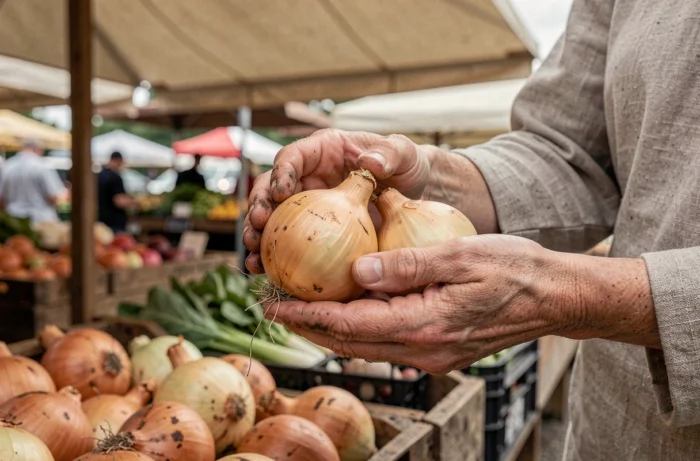
On a a market stall or in a supermarket bag, yellow onions look similar but are not identical. Their weight varies from one to three times depending on the size, and the label printed on the packaging (“50/70”, “60/80”) remains obscure for most buyers. Knowing how much a yellow onion weighs allows you to adjust your purchases accurately, whether for onion soup or a simple sauce base.
Standard sizes of yellow onions: what the numbers on the bag mean
The terms “small,” “medium,” or “large” that we use daily do not correspond to any official classification. The European wholesale trade relies on the UNECE FFV-25 standard, which classifies onions by equatorial diameter in millimeters. The common ranges are 40-60, 50-70, and 60-80 mm.
A bag labeled “50/70” therefore contains bulbs with a diameter between 50 and 70 mm. This range roughly corresponds to what recipes call a “medium” onion. A “60/80” bag contains larger bulbs, suitable for preparations that require a “large” onion.
The standard also imposes a homogeneity rule within the same batch: the diameter difference between the smallest and largest bulb is capped at 20 mm for sizes between 40 and 70 mm. This constraint explains the visual consistency of the bags sold in supermarkets. When you open a bag, the onions look alike because the standard requires it, not by chance.
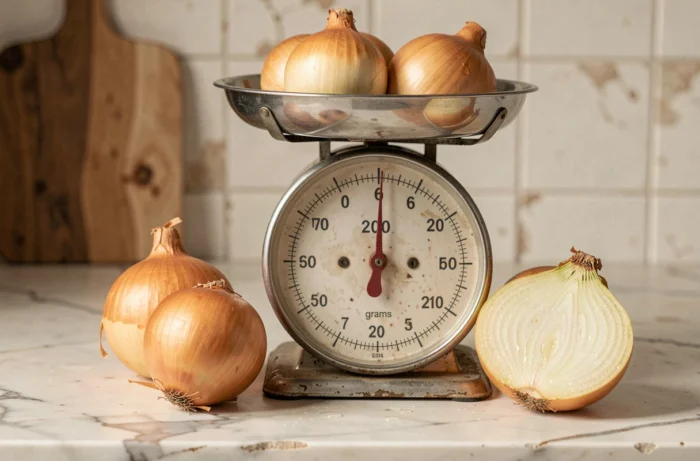
Average weight of a yellow onion by size
A medium-sized yellow onion weighs between 100 and 150 g, which translates to about 7 to 10 onions per kilogram. To better understand how much a yellow onion weighs, you need to look beyond this standard reference.
However, the discrepancies widen as soon as you move away from the standard size. A small onion (size 40-60) weighs less than 100 g, while a large specimen (size 60-80 and above) can exceed 200 g. The shape of the bulb also plays a role: a flattened onion may appear wide but often weighs less than a round onion of the same diameter.
Translating size into culinary use
A recipe that calls for “two medium onions” expects between 200 and 300 g of flesh. If you only have large onions on hand, one may be sufficient. Conversely, with smaller sizes, count on three or four to reach the same weight.
The scale remains the only reliable judge. Anglo-Saxon recipes often use weight in ounces or grams rather than the number of bulbs, which avoids any ambiguity related to size.
Choosing a yellow onion at the market: the criteria that really matter
Size is a useful piece of information, but it says nothing about the quality of the bulb. At a stall, three quick checks can effectively sort them.
- Firmness: a yellow onion should be hard under finger pressure. Any soft spot indicates the beginning of internal degradation, invisible from the outside.
- The skin: it should be dry, shiny, and tightly adhered to the flesh. A skin that easily peels away or shows dark spots indicates overly humid storage.
- The absence of sprouting: an onion that is starting to sprout has mobilized its reserves to produce a shoot. It remains edible, but its flesh is more watery and less flavorful when cooked.
Relative weight also gives a clue. Between two onions of the same apparent size, the heavier one contains more water and dense flesh. That’s the one to choose for onion jam or slow confit.
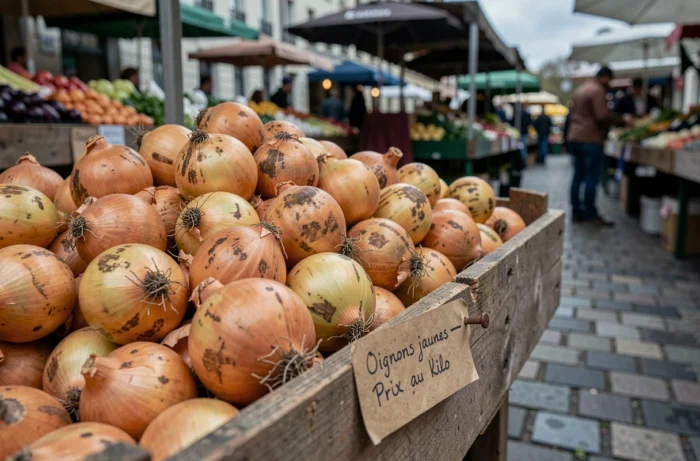
Storage onion or new onion: a seasonal question
Yellow onions sold from July to September are “new” onions, harvested before full maturity. Their skin is thinner, their flesh sweeter, but their shelf life does not exceed a few weeks.
Storage onions, harvested at full maturity in the fall, are those found all winter at market stalls. Their thick, golden skin protects them for several weeks in a dry, dark, and ventilated place. In the refrigerator, they soften. Near potatoes, they degrade each other.
Varieties of yellow onions and weight differences
Not all yellow onions are interchangeable. Some varieties naturally produce larger bulbs than others, complicating comparisons at the market.
The so-called “long-day” varieties, grown in northern France, tend to form medium to large bulbs due to the duration of summer sunlight. The “short-day” varieties, more suited to the south, often yield slightly smaller bulbs but with a more concentrated flavor.
This dominance of yellow onions over red and white explains why it is the reference size in most French recipes.
- For raw use (salads, pickles), prefer a small size: the flesh is proportionally less pungent and can be sliced into thin, even rings.
- For long cooking (soup, confit), a large size reduces peeling time for the same weight of usable flesh.
- For sauce bases and aromatic foundations, the medium size (50-70 mm) offers the best compromise between practicality and yield.
The choice of the right size therefore depends as much on the recipe as on the time spent peeling. A large onion provides more usable flesh per peeled bulb, but a small onion allows for more precise dosing without wasting half of it at the back of the refrigerator.
The next time you hesitate at a stall, weigh the bulb, check the firmness, and read the size on the bag: these three actions are enough to make the right choice.