
Artisanal sweets hold a special place in the French food landscape. Behind a soft caramel, a fruit paste, or nougat lies a technical and regulatory framework that most enthusiasts are unaware of. Understanding what distinguishes an artisanal confection from an industrial product allows for better choices and a greater appreciation of each bite.
Artisanal confectionery production: what the regulations really impose
Have you ever noticed the term “artisanal” on a candy or chocolate package? This word is not just a marketing argument. In France, the use of the term “artisanal” is strictly regulated by law.
For a confectioner to claim this designation, several criteria must be met simultaneously: registration in the national business register in the craft section, the activity must be listed on the official list of artisanal trades, recognized qualification (diploma or experience), and the company must have fewer than eleven employees at the time of its creation.
The stakes are not symbolic. The abusive use of the word “artisan” exposes one to a fine of up to 7,500 euros according to Article L241-1 of the Craft Code. This provision protects both professionals who adhere to the rules and consumers who pay more for a product they believe is handmade.
This legal framework clearly distinguishes France from many other countries where “artisanal” remains a purely marketing claim, without control or sanction. On Monde Gourmandises, you can find an overview of products from sectors that claim this regulated know-how.
Raw materials and know-how: what gives flavor to artisanal sweets
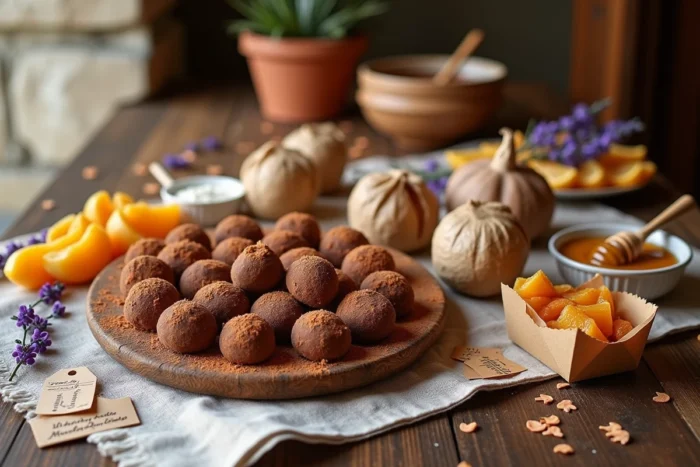
The difference between an artisanal confection and its industrial equivalent does not lie in the recipe. The basic formulas (sugar, fruit, butter, cocoa) are often similar. What changes is the way ingredients are selected and processed.
The choice of raw materials
An artisanal confectioner generally works with local or specialized suppliers. Fruits are selected at maturity, the butter comes from identified dairies, and the couverture chocolate is chosen for its specific aromatic profile.
This sourcing comes at a cost. The final price of an artisanal confection directly reflects the quality of the ingredients, while an industrial product primarily optimizes yield.
Handwork and slow cooking
Why does an artisanal caramel melt differently in the mouth? The answer often lies in the cooking process. Slow cooking at low temperatures preserves the volatile aromas that rapid industrial processes destroy. A confectioner monitors the temperature to the exact degree, adjusts the duration according to ambient humidity and batch size.
This attention to detail produces textures that are impossible to replicate in a factory: nougat that stretches without sticking, a fruit paste that retains crunch on the surface while remaining melting in the center.
Hygiene standards and traceability in artisanal confectionery
Making sweets in an artisanal workshop does not exempt one from adhering to strict sanitary rules. The HACCP plan (hazard analysis and critical control points) applies to all food businesses, including the smallest structures.
Specifically, an artisan confectioner must:
- Identify each potential hazard (contamination, allergens, cold chain break) and implement documented preventive measures
- Ensure complete traceability of raw materials, from the supplier to the finished product, with retention of documents for several years
- Train staff in good hygiene practices and maintain an up-to-date cleaning log for the workshop
- Comply with mandatory labeling: ingredient list in descending order, mention of allergens, minimum durability date
These obligations represent a considerable time investment for a small team. They partly explain why artisan confectioners remain small businesses, rarely exceeding a dozen employees.

Recognizing an authentic artisanal sweet: concrete criteria
In the face of the proliferation of products labeled “homemade” or “traditional,” how can one distinguish a true artisanal sweet from a well-packaged imitation?
- Check that the manufacturer is registered as an artisan. This information is accessible on the national business register
- Read the ingredient list: an artisanal product rarely contains more than five to eight components. The absence of artificial flavors, synthetic colorants, and chemical preservatives is a reliable indicator
- Observe the consistency of the product. Slightly irregular shapes, color variations from one batch to another are signs of manual production, not defects
Price is also a benchmark. An artisanal confection costs significantly more than its industrial equivalent, because the manufacturing time, quality of ingredients, and batch sizes do not allow for the same economies of scale.
Artisanal sweets and sales channels: where to find them
Artisanal confections are rarely sold in large supermarkets. They are mainly found in dedicated shops, at local markets, in gourmet grocery stores, and on specialized online platforms.
This distribution method has a direct consequence: the link between the manufacturer and the buyer remains short. The confectioner can explain their choices, tell the origin of their ingredients, and offer tastings. This proximity is part of the experience, just like the taste of the product.
Regional artisanal markets, such as those organized in several major French cities, also provide an opportunity to compare styles. Each artisan develops a unique taste signature, linked to their terroir, suppliers, and manufacturing techniques.
The next time you hesitate between two packages of confections, turn the packaging over. The ingredient list and the manufacturer’s status will tell you more than any advertising argument.