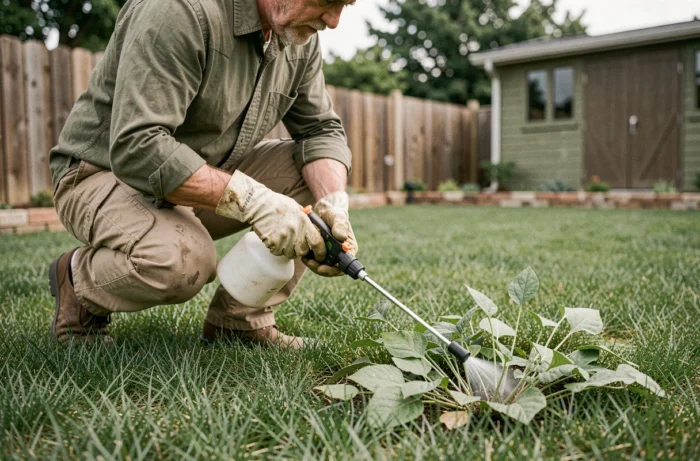
A selective lawn treatment involves eliminating weeds (dandelions, clovers, plantains) without destroying the grasses that make up the lawn. The principle is based on a physiological difference: the active molecules target broadleaf plants (dicotyledons) while sparing the grasses. Since the Labbé law, French individuals no longer have access to synthetic selective herbicides, which radically changes the method to be adopted.
Labbé Law and Biocontrol Products: What Individuals Can Still Use
Since January 1, 2019, the purchase, use, and possession of synthetic phytosanitary products are prohibited for individuals in France. Classic molecules such as 2,4-D, dicamba, or MCPA are therefore no longer an option for treating your lawn.
In 2022, this ban was extended to private places open to the public (co-ownerships, campsites, hotels). Only professionals working on sports fields or golf courses still benefit from exemptions, which are extended until July 1, 2028.
For a private garden, there are two categories of legal products remaining:
- Biocontrol products, which exploit natural mechanisms to limit weeds without destroying grasses
- Base substances such as pelargonic acid or acetic acid, whose selectivity remains limited compared to former chemical herbicides
- Products labeled EAJ (Authorized for Use in Gardens), which are the only ones allowed for sale to individuals
This regulatory constraint requires rethinking selective treatment not as a simple spraying, but as a sequence of complementary cultural practices. Finding lawn tips on Agri Systems helps to structure this approach step by step.
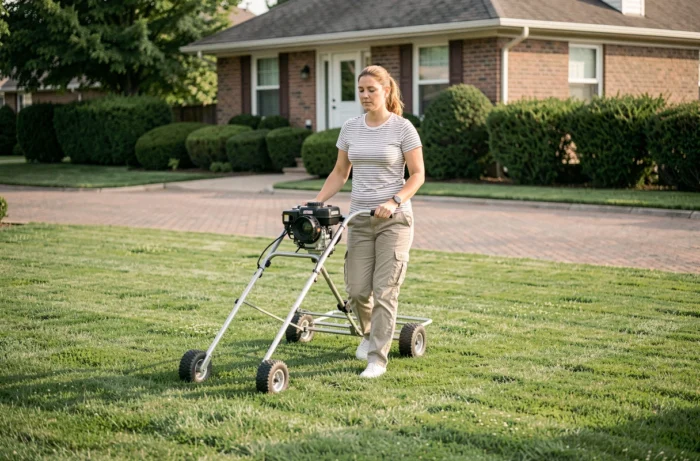
Lawn Diagnosis Before Selective Treatment: Identifying Weeds
Applying a product without knowing what you are combating is a waste of time and money. Each weed calls for a different response. A creeping clover is not treated like a tap-rooted dandelion, and moss indicates a problem with acidic or poorly drained soil that no herbicide will solve.
Start by walking through the lawn and spotting the affected areas. Broadleaf weeds (plantain, daisy, clover) are the classic targets of a selective treatment. Undesirable grasses (couch grass, ryegrass) pose a more complex problem since selective treatments against dicotyledons do not affect them.
Assessing Soil Condition
A lawn overrun with weeds almost always signals an imbalance: compacted soil, overly acidic pH, nitrogen deficiency, or too short mowing. Correcting the soil reduces weed pressure much more sustainably than a one-time treatment.
Check the drainage by observing if water stagnates after rain. Aerating with a scarifier or garden fork, done in spring or early autumn, improves soil structure and encourages grass rooting at the expense of weeds.
Preparing the Ground and Mowing Before Application
Mowing plays a direct role in the effectiveness of the treatment. Mowing a few days before application allows weeds to develop enough leaf surface to absorb the product. Mowing too short just before treatment reduces the contact area between the product and the leaves of the weeds.
Set the cutting height to leave the grass at an average height. Grass mowed too short encourages the germination of weed seeds by allowing light to reach the soil.
Watering and Weather Conditions
The soil should be slightly moist for the grass roots to be active and resilient. In contrast, the leaves of the weeds must be dry at the time of spraying for the product to adhere properly.
Apply on overcast days, with no wind and no rain forecast in the hours that follow. Early rain washes away the product before it penetrates the plant tissues, making the treatment ineffective.
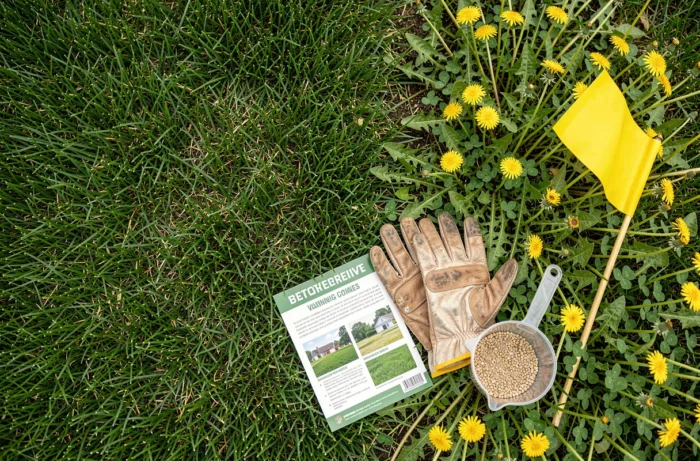
Applying the Selective Product on the Lawn: Method and Dosage
For small areas, a manual pressure sprayer offers precise control. On a larger lawn, a backpack sprayer allows for even distribution. The consistency of the application matters more than the amount of product.
Strictly adhere to the dosage indicated on the packaging of the EAJ product or biocontrol. Overdosing does not kill weeds better; it risks burning the grasses and upsetting the soil microflora.
Spraying Technique
Move at a steady pace, sweeping the spray from left to right, with a slight overlap between each pass. Treat area by area rather than the entire lawn if the weeds are localized. This approach reduces the amount of product used and limits the impact on soil organisms.
After application, avoid mowing for at least a week. Weeds need this time to absorb the active substance through their leaves and translocate it to their roots.
Post-Treatment Follow-Up and Reseeding Treated Areas
The first signs of wilting in weeds usually appear after a few days. Some resistant species, such as ground ivy, may require a second application after several weeks.
The weeded areas leave bare soil conducive to recolonization. A quick overseeding with grass seeds suited to your soil and exposure fills these spaces before new weeds settle in.
- Lightly scratch the surface to allow grass seeds to come into contact with the soil
- Water regularly with fine mist for the two to three weeks following seeding, without over-saturating
- Resume mowing only when the young shoots reach a sufficient height to avoid being uprooted by the blade
An application of slow-release organic fertilizer after reseeding strengthens lawn density. A dense and well-nourished lawn provides the best barrier against the return of weeds, much more reliable than repeated chemical treatments season after season.