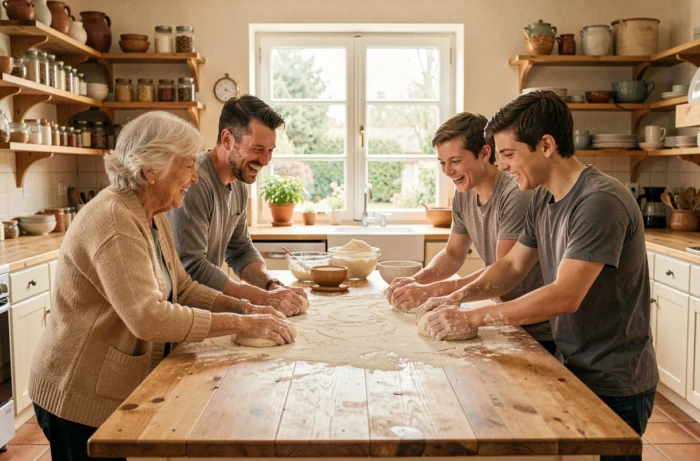
Family ties are not decreed: they are built through regular, even brief interactions that create a sense of security and belonging. Strengthening family ties on a daily basis relies on concrete, reproducible mechanisms that are often underestimated in their cumulative effect.
Desynchronization of rhythms: the first obstacle to family ties
Before looking for activities to share, it is essential to identify what prevents sharing. Anses warns about the impact of atypical hours (evenings, nights, weekends, long shifts) on family life. These disrupted rhythms lead to a desynchronization with collective rhythms such as school or leisure, which deteriorates social and family life.
Remote work has changed this equation. The proportion of employees working remotely at least occasionally rose from 9% in 2019 to 26% in 2023 according to Dares. Remote workers generally report a better balance between professional and personal life, with a frequent gain of between one hour and one and a half hours per day on commuting.
This recovered time is not automatically reinvested in the family. Without a clear intention, it gets dispersed into household tasks or additional work. The question is therefore not just about having time, but about protecting dedicated slots for family life. Resources like lavoiedelafamille.com help structure this reflection around parenting and daily life.
Shared meals: an underutilized lever for family communication
Family meals are one of the few moments when all members are physically in the same place, without imposed parallel activities. Their effectiveness on family communication relies more on their regularity than on their duration.
An OpinionWay survey for HelloFresh reveals that by 2026, 17% of French people declare they want to ban screens at the table. This figure reflects an awareness: mere physical presence is not enough if everyone is looking at their phone.
Three conditions transform an ordinary meal into a moment of real connection:
- Asking an open-ended question at the beginning of the meal, such as “What was the most surprising moment of your day?” rather than “Did school go well?” which invites a yes or no answer
- Allowing each person to finish speaking before responding, including the youngest children, which establishes a habit of active listening
- Accepting silences without filling them, as they signal a space of comfort rather than a failure of conversation
Frequency matters more than perfection. A shared meal four evenings a week, even if brief, produces a cumulative effect that two “event” dinners a month cannot replace.
Daily micro-rituals and children’s sense of security
A family ritual does not need to last long to be effective. What matters is its predictability and repetition. Children build part of their sense of security on the ability to anticipate what will happen.
An identical bedtime ritual each night (story, song, recurring phrase) acts as a transition signal that reduces stress. The same principle applies to a welcoming moment after school or a fixed activity on Saturday mornings.
Effective rituals vs. decorative rituals
The difference between a ritual that strengthens bonds and a “for show” ritual lies in mutual attention. Watching a movie together without ever discussing it afterward remains a parallel activity. The ritual becomes bonding when it includes an exchange, even minimal.
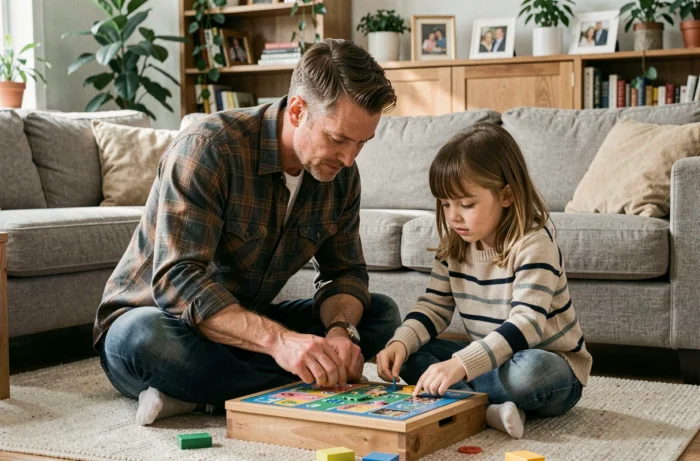
A weekly board game works better than a shared screen, not because the game is inherently superior, but because it requires direct interaction: waiting for your turn, negotiating, reacting to what the other does. Cooperative games, where players win or lose together, particularly enhance family dynamics.

Active listening between parents and children: a skill to be developed
Active listening refers to receiving what the other person says without preparing a response while they are speaking. In the family context, this skill faces a specific obstacle: parents filter what they hear through their educational role. A child recounting a conflict at school often receives advice before finishing their story.
Rephrasing what the child has just said (“If I understand correctly, you were frustrated because…”) before giving an opinion changes the dynamic. The child feels heard, and the parent gains a more complete version of the situation.
Adapting listening to age
A four-year-old does not verbalize their emotions the same way a teenager does. With younger children, observing behavior (restlessness, withdrawal, aggressive play) complements what they cannot articulate. With teenagers, timing is as important as method: a conversation in the car, without direct eye contact, often facilitates sharing more easily than a face-to-face discussion at the table.
Parents working irregular hours can maintain this connection through written notes, short voice messages, or a shared notebook. The tool matters little. What strengthens the bond is the regularity of the “I’m thinking of you” signal.
Screen management: setting a framework without creating ongoing conflict
Screens are not the enemy of family ties, but their unregulated use is. The concrete problem: each family member can isolate themselves in their own digital bubble while being physically present in the same room.
Rather than a blanket ban that often leads to tensions, a negotiated framework works better:
- Defining together screen-free zones or times (meals, the first half-hour after returning home, bedrooms after a certain hour)
- Offering concrete alternatives rather than just saying “put down your phone”: a game, a walk, a shared task like cooking
- Applying the same rules to parents, as an asymmetrical framework loses its legitimacy in the eyes of children immediately
Consistency between what parents demand and what they practice remains the most decisive factor. A child who sees their parents put down their phones during dinner internalizes the norm without needing to repeat it.
Family ties are rarely strengthened by grand gestures. It is the daily micro-interactions, protected from distractions and repeated consistently, that create a lasting sense of closeness. The shared meal, the evening ritual, the question asked in the car: each of these moments weighs little in isolation, but their accumulation constitutes the real fabric of family life.