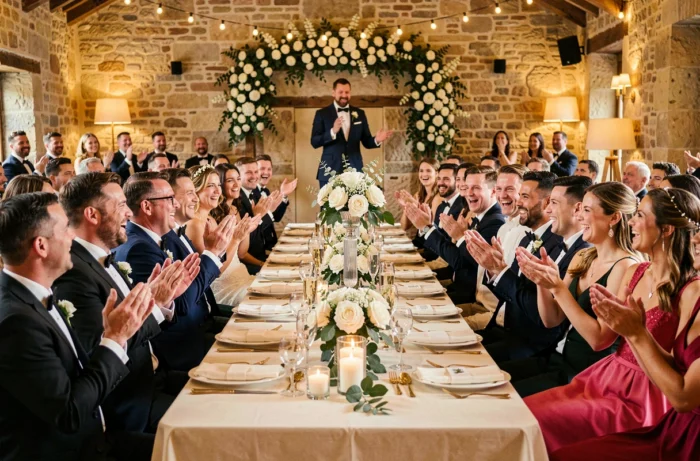
The animation of a wedding meal refers to any scheduled intervention between courses to maintain the energy of the table over several hours. The meal represents the longest time block of the reception, and each animation must fit into the windows left free by the catering service. Here are ten concrete formats, tested in real conditions, to pace this moment without overwhelming it.
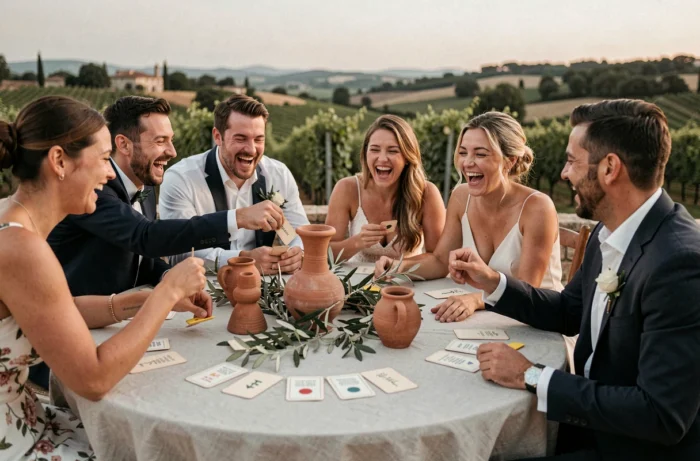
1. The sound quiz by tables with handmade buzzers
Each table receives a noisy object (bell, bicycle horn, pot lid) as a buzzer. The master of ceremonies plays short music excerpts or reads quotes, and the first table to identify the reference scores a point.
This format works because it engages the entire table, not just a single volunteer. To find other successful animations on Info Mariage, the principle remains the same: prioritize the collective over the solo. Limit the quiz to about ten rounds to avoid encroaching on the next course.
2. The time capsule sealed at the end of the meal
A box circulates from table to table during dinner. Each guest slips in a note, a prediction, or a memory on a card provided next to the plate. The couple commits to opening the capsule on a specific date, often an anniversary.
The strength of this animation lies in its discretion: it does not interrupt conversations and requires no staging. The box can be a simple glass jar, an engraved wooden box, or a vintage suitcase that matches the decor.
3. The photographic red thread with a challenge per course
Each course corresponds to a photo challenge displayed on an easel or slipped under the plates. Starter: “photograph the most contagious smile at your table.” Main course: “find two guests who didn’t know each other before today.” Dessert: “capture an improvised dance step.”
The photos feed a digital wall projected in real-time via a sharing app or a simple hashtag. This format creates a visual narrative of the meal without interrupting the service, and the guests who are less comfortable with group games participate naturally.
4. The cross-portrait notebook
Each guest receives a card with the first name of another guest, drawn at random. The instruction: draw their portrait (even clumsily) and write three words that describe them, then hand the card to them before dessert.
This animation breaks the ice between guests who do not know each other and produces a paper keepsake that everyone takes home. It is particularly suitable for weddings that bring together very different social circles.
5. The acoustic musical intervention between two courses
A voice-guitar duo or a small acoustic ensemble plays two to three pieces between the main course and dessert. The volume remains conversational, which avoids any conflict with regulations on amplified music.
In France, decree n°2017-1244, supplemented by the order of April 17, 2023, imposes sound level thresholds and a control system in public venues. An unamplified acoustic set circumvents this constraint while offering an intimate musical moment, very different from the DJ atmosphere that will come later in the evening.
6. The envelope game with challenges spread over the year
Twelve numbered envelopes (one for each month) are placed at the center of the head table. At a signal, twelve volunteers come to pick one. Each envelope contains a dated challenge: prepare a dinner for the couple in March, organize a hike in June, send a postcard in August.
This system extends the celebration well beyond the evening and creates regular appointments with loved ones. The challenge should remain achievable: avoid costly or burdensome challenges that would end up being ignored.
7. The blind tasting commented by the caterer
The caterer presents a bite or a food-wine pairing without revealing the ingredients. The tables guess the composition, and the chef then reveals the recipe. This format highlights the caterer’s work and provides concrete content for table conversations.
Coordinate this animation with the head waiter so that it falls between two servings, never during the plating of the dishes. One round is enough: the blind tasting loses its effect if repeated.
8. The collaborative speech built during the meal
Instead of a single speech prepared by the witnesses, each table collectively writes a sentence or advice to the couple on a large sheet. The witnesses gather the contributions and read the composite speech before dessert.
- The result is unpredictable, often funny, sometimes touching, and involves the whole room without putting anyone under individual pressure.
- Family tables usually bring childhood anecdotes, while friends share recent memories, creating a natural chronological narrative.
- Provide a thick marker and a cardboard sheet per table so that the text remains legible from a distance.
9. The projection of video messages from those absent
Loved ones who could not be present record a short video message in advance. These clips are edited into a film of a few minutes, projected between two courses.
This format fills an emotional gap that other animations do not address: that of distant grandparents, expatriate friends, or loved ones who are unable to attend. Keep the montage under five minutes to maintain the room’s attention.
10. The controlled sound transition to the dance party
The last minutes of the meal serve as a buffer between the table and the dance floor. The DJ or host gradually increases the musical tempo while remaining below the conversational threshold, then announces the opening of the dance.
Between 10 PM and 7 AM, noise disturbances can be characterized by sounds that are simply audible from outside, without decibel measurement. Planning this transition avoids a sudden increase in sound that would pose problems in areas located in residential zones. Inform the DJ of this constraint during the technical briefing.
- Start the musical transition about fifteen minutes before the expected end of dessert.
- Choose songs that guests recognize to create a collective desire to get up.
- Coordinate the exact moment of the opening dance with the clearing of the last plates.
A successful wedding meal relies on a principle of dosage: each animation occupies a short window, calibrated with the rhythm of the service. Four to five of these ten formats are enough to cover several hours at the table without exhausting the room before the first dance.