
In France, homelessness is not limited to visible individuals in public spaces. A growing part of residential precariousness escapes traditional systems: temporary housing with third parties, families with children being shuffled from hotel to hotel, administrative breaks that push already vulnerable individuals onto the streets. This multifaceted reality makes supporting homeless and vulnerable individuals more complex than just a simple issue of available spaces.
Housing with Third Parties: The Hidden Face of Homelessness in France
Outreach teams, emergency shelter centers, and the 115 hotline capture some distress situations. However, they overlook a massive phenomenon: individuals without homes who are precariously housed with family, friends, or mere acquaintances.
The Hebtiers research project, led by the Samu Social de Paris, documents this reality in Île-de-France. According to its data, nearly half of the users of day shelters who have experienced homelessness in the past twelve months rely on housing with third parties. The survey, which runs from 2023 to 2025, analyzes individual trajectories, relational dependency, and the risks of abrupt breaks in these arrangements.
This finding changes the nature of the necessary support. When precariousness is based on a fragile interpersonal link, relevant responses involve family mediation, prevention of housing breaks, and legal support for hosts. Associations and collectives are working on these specific approaches, as shown by the portal https://samhweb.org/ which lists mutual aid resources for vulnerable individuals and their surroundings.
Homeless Children: A Social Emergency on the Rise
The issue of children living on the streets is one of the most documented angles in recent years, and the available figures indicate a clear worsening. According to the barometer from the Federation of Solidarity Actors, the number of children without housing solutions has increased by 42% since 2022.
This increase does not only reflect a lack of spaces. It reveals a chain of dysfunctions:
- Families denied asylum or awaiting regularization find themselves without guidance due to a lack of coordination between housing systems and administrative procedures.
- Emergency housing capacities, under budgetary pressure, struggle to absorb the additional flows related to evictions and exits from temporary structures.
- Municipalities, on the front lines, must compensate for the state’s shortcomings, sometimes through legal means. The administrative court condemned the state to pay 540,000 euros to the city of Strasbourg for failing to provide emergency housing.
For the mobilized associations, the priority lies as much in prevention as in providing shelter. A child who spends several months without stable housing accumulates educational delays, health issues, and social isolation whose effects persist long after their time on the streets.
Emergency Housing and Budget Cuts: The Tensions in the System
The operation of emergency housing in France is based on a principle of unconditional shelter. Anyone without a home can call 115, a free number accessible every day. In practice, the saturation of the system makes this right largely theoretical in large urban areas.
Field reports vary on the exact extent of the shortage of spaces, but there is a consensus on the trend: recent budget cuts are increasing pressure on a system already at its limits. Several grassroots associations report closures of winter spaces that are not compensated in the spring, creating yo-yo effects in care provision.
The “Housing First” logic, a public policy aimed at directing homeless individuals towards permanent housing rather than temporary shelter, remains a reference framework. The available data does not yet allow for conclusions about its effectiveness on a large scale, especially since its implementation varies greatly by region.
The Role of Volunteers and the Community in the Social Network
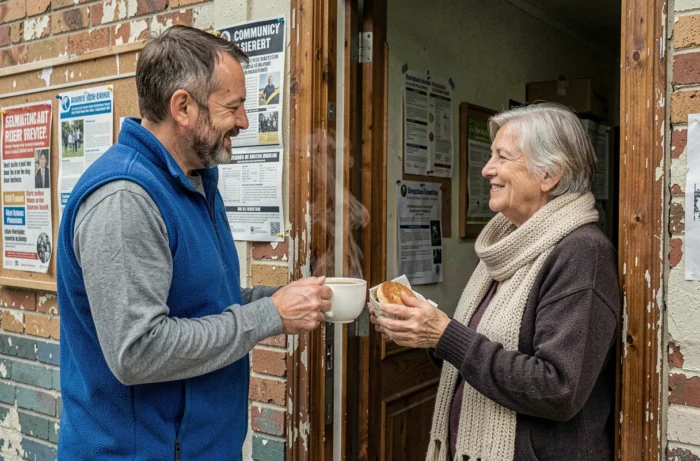
Beyond the structures, support largely relies on volunteers. Outreach teams remain the first point of contact for many people on the streets. The regular human connection often serves as a prerequisite for any integration efforts.
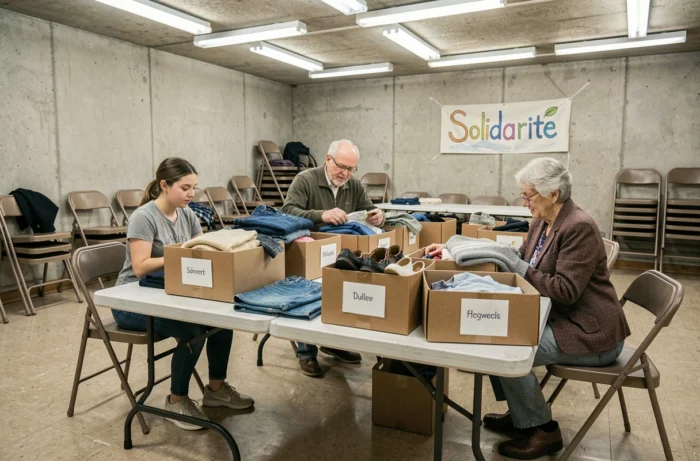
Grassroots associations emphasize one point: material aid (meals, blankets, clothing) is not enough without comprehensive social support. Listening, directing individuals to existing systems, helping to restore lost social rights—these actions require time and a minimal level of training for the interveners.
Vulnerable Individuals and Precariousness: Diversifying Profiles
The profile of homeless individuals or those in extreme precariousness has significantly broadened. Women, single-parent families, and youth exiting child welfare represent an increasing share of the populations served in emergency structures.
For women on the streets, the issue of safety adds to that of housing. Several specific systems exist (women’s shelters, non-mixed accommodations), but their geographical coverage remains uneven. Outside of Paris and major metropolitan areas, access to these specialized structures is becoming scarce.
Individuals with disabilities represent another blind spot. Although the right to housing is theoretically unconditional, suitable spaces remain rare. Coordination between the medical-social sector and the emergency housing sector still operates in a siloed manner in most regions.
Supporting homeless and vulnerable individuals faces a structural paradox: needs are diversifying and intensifying while resources are contracting. Effective responses combine stable housing, individualized social follow-up, and lasting human connections, three components that neither budgetary urgency nor standardized systems can guarantee alone.