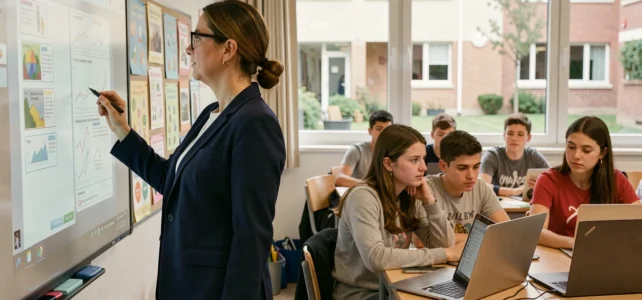
When a high school principal discovers at the start of the 2026 school year that he must confiscate his students’ mobile phones without a designated storage area, the ministerial circular takes on a whole new dimension. Educational trends in France are not limited to headlines about the baccalaureate or curricula: they are played out in the concrete constraints faced by schools, teachers, and families on a daily basis.
Ban on mobile phones in high school: what it changes on the ground
After middle school, which has been affected since the law of August 3, 2018, the ban on mobile phones now extends to high schools starting in the 2026 school year. The measure is included in the back-to-school circular and its implementing texts. We move from a societal debate (hyper-connectivity of adolescents, cyberbullying, attention in class) to a legal constraint that each institution must organize.
In practice, feedback varies on this point. Some high schools had already experimented with phone lockers, while others have no suitable infrastructure. The logistical question (storage, responsibility in case of theft, management of repeat offenses) occupies school management teams more than the principle itself, which is largely accepted by staff.
The educational news published on edunews.fr allows for tracking the implementation of these measures in the academies. The topic goes beyond simple regulation of digital technology: it touches on the organization of school spaces and relationships with families, who must be clearly informed of the new rules.
Refocusing on the fundamentals in primary school: French and mathematics as priorities
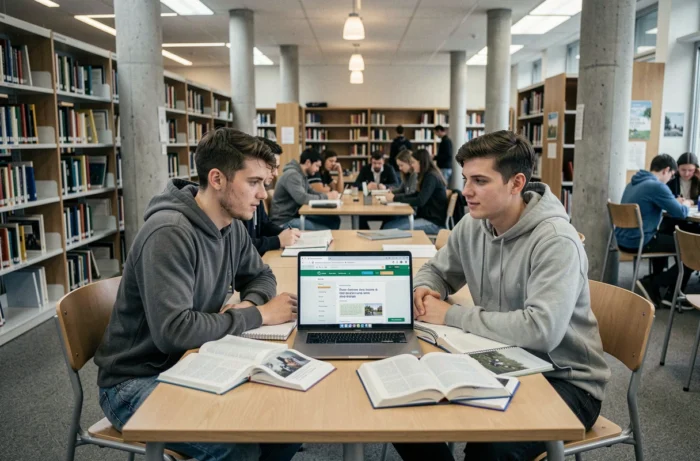
The 2026 back-to-school circular establishes a clear pedagogical steering choice: to focus efforts on two fundamental skills, French and mathematics. This refocusing is not just a slogan. It translates into increased hours, more frequent national assessments, and targeted training for primary school teachers.
This choice may seem reductive. However, it has the merit of clarity for teaching teams, who know precisely where to concentrate their time. Media controversies often focus on school uniforms or disciplinary issues, but this curricular refocusing restructures the daily life of the classroom more profoundly.
What it implies for teachers
The continuous training offered to primary school teachers is increasingly oriented towards the didactics of French and mathematics. The educational resources provided by the ministry follow the same logic. For a teacher in post, this means less dispersion between ancillary subjects and more tools focused on fundamental learning.
- Strengthening time slots dedicated to reading and writing from the first grade, with more regular follow-up assessments
- Providing structured national resources in mathematics, aligned with end-of-cycle expectations
- Continuous training refocused on the didactics of these two subjects, at the expense of more transversal modules
Prepa-second class: a new program for students struggling after middle school
The 2026 decree formalizes the prepa-second class, open to voluntary students who wish to consolidate their knowledge before entering a general, technological, or vocational second year. The goal is to reduce early dropouts in high school by filling the gaps accumulated in middle school.
On the ground, implementation heavily depends on the resources allocated by each academy. We talk about reduced class sizes and enhanced support, but the concrete modalities (number of classes opened, profile of assigned teachers, coordination with vocational training) remain variable from one rectorate to another.
A useful program, but under conditions
The value of the prepa-second class lies in its positioning: it targets students identified as fragile, at a pivotal moment in their educational journey. Without sufficient resources, the risk is to create a path of relegation rather than a springboard. Initial feedback from pilot institutions shows that the quality of pedagogical supervision makes all the difference.
Artificial intelligence and teacher training: where do we stand concretely
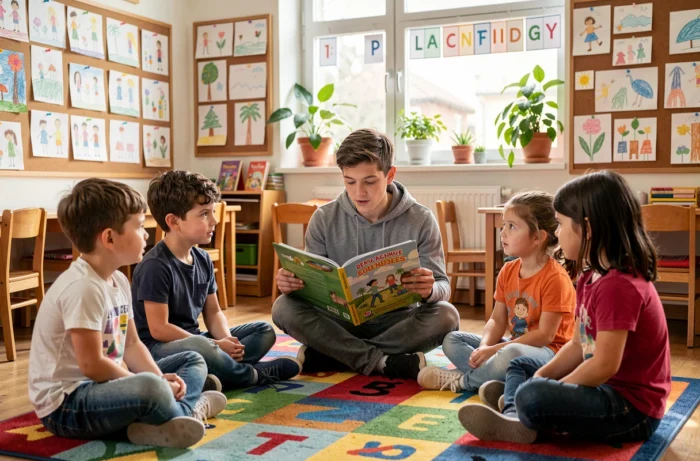
Artificial intelligence in education has generated a lot of ink, but in French classrooms, the reality remains modest. A few academies are experimenting with AI tools for differentiated instruction or automated grading, without a coordinated national rollout.
The real challenge lies in teacher training. Most teachers have received no specific training on the use of AI in their practice. Academic training plans are beginning to integrate dedicated modules, but we are still far from a widespread increase in skills.
- Some rectorates offer workshops on using AI tools to adapt exercises to each student’s level
- Recruitment competitions do not yet include a component related to advanced digital technology or AI
- Willing institutions are testing assisted grading solutions, mainly in languages and mathematics
The issue of student data protection also hinders initiatives. The AI tools available on the market do not all meet the requirements of the GDPR as applied to minors, complicating the selection of reliable solutions by teaching teams.
Education in France is undergoing a period of silent transformations. The ban on phones in high school, the refocusing on French and mathematics, the creation of the prepa-second class, and the initial steps of AI in the classroom are shaping a changing educational landscape. These developments are measured less in ministerial announcements than in the ability of institutions to translate them into daily practice, with the resources they have available.